Research
Education in Neurocognitive Aging: Implications for Cognitive Reserve
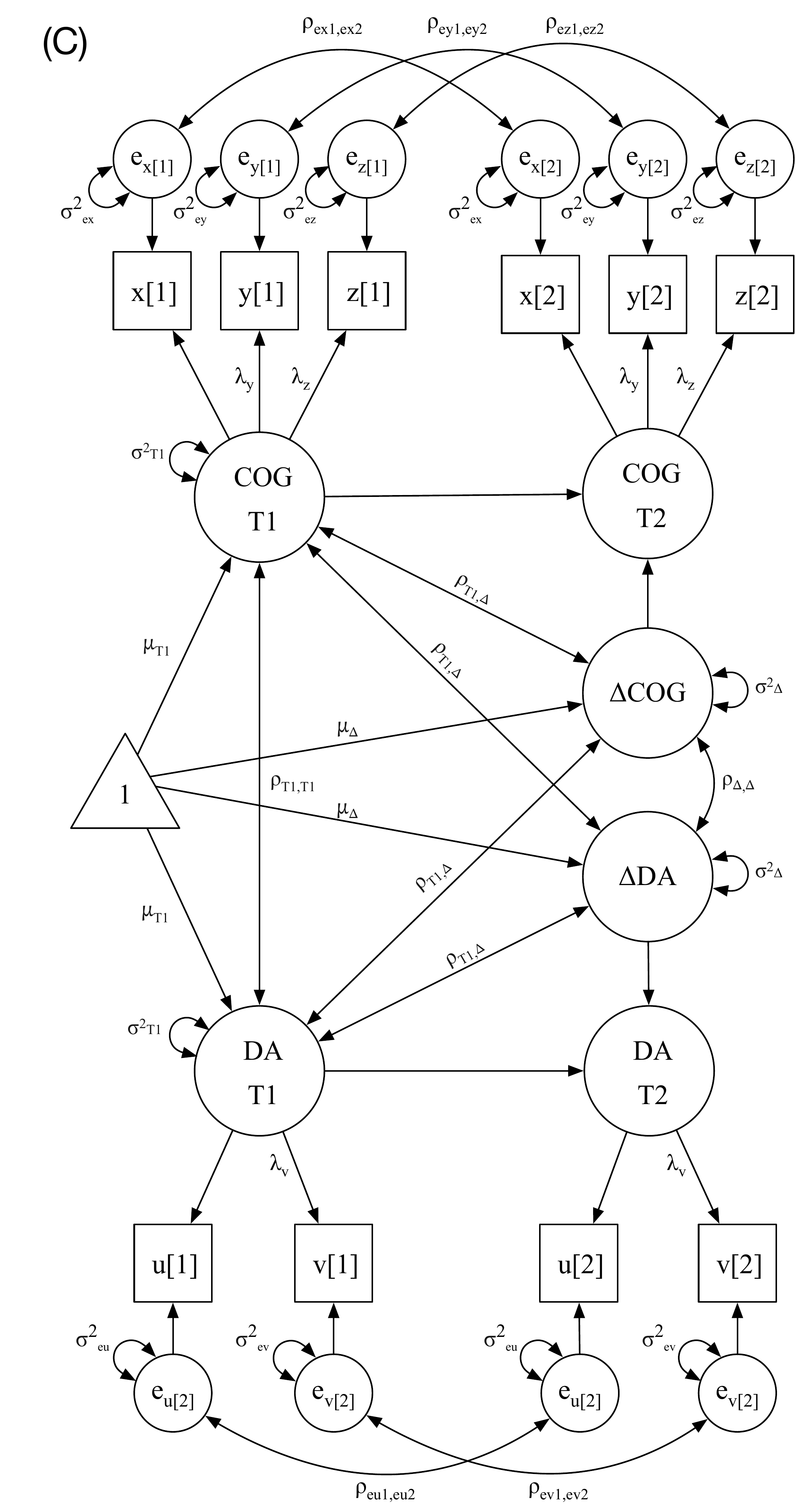
My dissertation examines whether education slows brain aging or moderates the association between brain aging and cognitive decline in healthy adults (as predicted by the cognitive reserve hypothesis). I use structural MRI and dopamine ([11C]raclopride) PET data from the COBRA prospective cohort study, along with harmonized structural MRI data from the Lifebrain Consortium, to track longitudinal changes in gray matter, white matter integrity, and dopamine D2 receptor availability alongside episodic memory, working memory, and processing speed — modeled jointly through a pipeline of hundreds of Bayesian structural equation models spanning brain regions, cognitive domains, and model specifications.
Research Interests
Brain & Cognitive Aging
What drives individual differences in aging trajectories? I work with longitudinal dopamine PET, structural MRI, and cognitive data to understand how brain and behavioral changes relate to each other — and what factors shape those relationships. I am increasingly interested in extending this work to preclinical Alzheimer's disease, integrating tau/amyloid PET and fluid biomarkers with longitudinal cognitive modeling.
Measurement & Harmonization
Longitudinal research requires that instruments measure the same construct across time and groups. I test measurement invariance, validate scales, and evaluate how scoring choices (sum scores, factor scores, plausible values) propagate into downstream inference. These methods also extend naturally to cross-cohort data harmonization, where ensuring comparability across studies and platforms is essential.
Computational Methods for Aging Research
I build scalable computational pipelines for Bayesian modeling of multimodal longitudinal data. This approach allows comprehensive, systematic analysis of complex datasets rather than selective testing of individual models.
Publications
Peer-reviewed articles and manuscripts.
Five-Year Associations Among Dopamine D2-Like Receptor Loss, Cognitive Decline, Education, and Self-Reported Leisure Activities in Healthy Older Adults
Pagin, A., Karalija, N., Andersson M., Nyberg, L., Bäckman, L., Riklund, K., Lindenberger, U., & Lövdén, M.
No Moderating Influence of Education on the Association Between Changes in Hippocampus Volume and Memory Performance in Aging
Lövdén, M., Pagin, A., Bartrés-Faz, D., Boraxbekk, C-J., Brandmaier, A. M., Demnitz, N., Drevon, C.A., Ebmeier, K. P., Fjell, A. M., Ghisletta, P., Gorbach, T., Lindenberger, U., Plachti, A., Walhovd, K. B., & Nyberg, L.
Exploring the Conjunction Fallacy in Probability Judgment: Conversational Implicature or Nested Sets?
Pagin, A.
In Preparation
No Credible Evidence That Education Contributes to Cognitive Reserve Across Dopaminergic and Structural Imaging Measures in Healthy Aging
Pagin, A.
Psychometric Evaluation of an 18-Item Swedish Adaptation of the Broad Learning Adult Questionnaire in Older Adults
Bjälkebring, P., Burén, J., Hansson, I., Klapp, A., Lövdén, M., & Pagin, A.
Factor Structure and Longitudinal Measurement Invariance of the Satisfaction With Life Scale
In a cohort of Swedish older adults. Pagin, A.